

“Please make it like the sample” leaves several questions unanswered. Which sample? Is its color approved, or only its shape? Does the packaging belong to the order? What happens if the next version looks slightly fuller?
A lash product specification sheet connects those decisions. It does not need elaborate software. A controlled document with a clear code, useful photographs and a short approval record is often easier to use than a long email chain.
Identify the reference precisely
Start with the brand’s product code, the working style name, the product format and the document revision. Give physical samples their own reference as well. “Sample B, received 27 October, revision 2” is a usable record; “the latest sample” becomes ambiguous as soon as another parcel arrives.
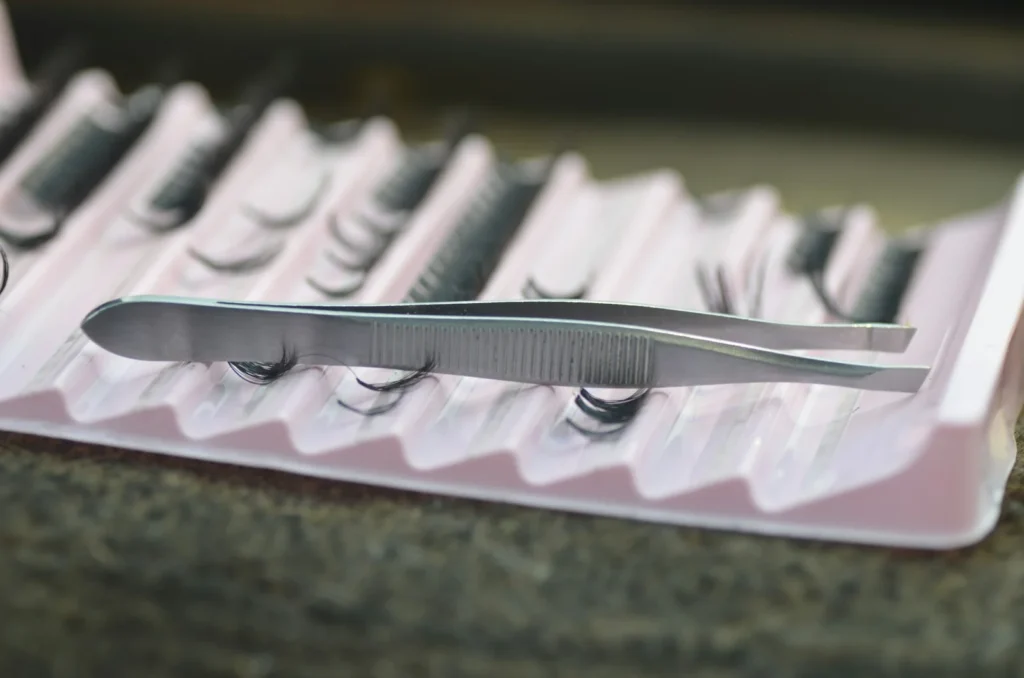
Photograph the sample from above and from the side, with the tray and row labels visible where relevant. Keep the original files. A close crop can show fiber arrangement, but it may hide the base or make the product appear denser than the full tray does.
State which parts of the reference are approved. You might accept the length sequence while still reviewing the shade or tray. Record those decisions separately so that an approved detail is not accidentally reopened with the next revision.
Describe the pattern, not just the style name
Words such as natural, wispy and dramatic are useful for discussing direction. They leave too much room for interpretation when used as the whole production brief. Describe the features that make the reference recognizable.
- For a strip: base or band construction, overall profile, inner-to-outer length pattern and visible spacing.
- For clusters: base width or shape, length assortment, placement of longer fibers and count per tray.
- For extension trays: the agreed curl reference, diameter designation, length labels, row arrangement and tray configuration.
- For every format: material designation, shade, finish and any feature that must remain consistent between orders.
Include a physical reference for color, curl or finish when those details matter. A color name on a screen cannot replace an approved sample viewed under agreed conditions. A supplier’s material designation should also be recorded rather than inferred from appearance.
Agree on how a dimension will be checked
A measurement is incomplete without a method. If length is important, agree on the reference points, the measuring tool and how the curved fibers are positioned during the check. Do the same for band or base width. This prevents two teams from obtaining different results while each believes it has followed the specification.
Write units beside the value. Keep nominal targets and permitted variation in separate fields. Tolerances should be discussed for the actual product and measurement method; copying a number from an unrelated lash format can create an acceptance rule that neither side intended.
Include removal, presentation and packaging fit
A tray that looks correct can still present a handling problem. Specify how the product is intended to be removed from its holder and what condition it should remain in after normal removal. Agree on the method before using removal damage as a reason to reject a sample.
Record the count, layout, row labels and orientation inside the retail pack. Check that the chosen tray fits the approved carton without pressing on the lashes. If a tool, adhesive or instruction insert is included, identify it as a separate component; do not let “complete kit” become a substitute for a packing list.
The packaging specification should use the same product code and retail-unit definition. Otherwise, the product and the carton can each be correct on paper and still be wrong together.
Keep the working sheet short enough to use
The example below shows the structure of a specification. The entries describe the kind of information to record, not Aerilia’s standard options or guaranteed tolerances.
| Field | What to record | Approval evidence |
|---|---|---|
| Identity | Product code, format and revision | Dated document |
| Appearance | Pattern, shade, finish and base construction | Numbered sample and photographs |
| Dimensions | Targets, units, method and agreed tolerances | Recorded measurements |
| Retail unit | Count, assortment and tray arrangement | Approved packed sample |
| Packaging | Tray and carton references, artwork version | Physical pack and final artwork |
| Acceptance | Defect definitions and checks to perform | Inspection sheet and approval record |
Make changes visible to the next person
Keep a brief revision log: what changed, why it changed and who accepted it. When the base is changed after a handling trial, for example, update the sample reference and the sheet together. An email approval should identify the same revision that appears on the production brief.
Before a repeat order, confirm whether it repeats the existing revision or introduces a new one. Packaging changes, a revised length mix and a new shade should not disappear into an unchanged product nickname.
Use the sample inspection checklist to test whether the sheet contains enough detail to support an approval. For a new project, the custom solutions page provides the relevant route into Aerilia’s product and packaging discussions.